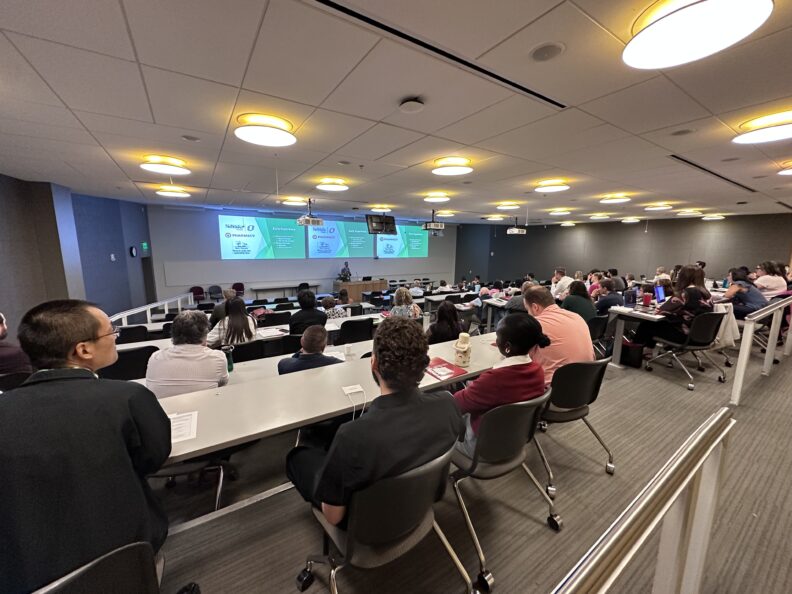
What can a student do with an undergraduate, Doctor of Pharmacy, or graduate degree? At Washington State University’s sixth annual Industry Advisory Board meeting, students got a firsthand look at the many paths available in the pharmaceutical and biomedical industries—from drug discovery and clinical research to medical affairs, rural health and leadership.
Held August 13-14 at the WSU Health Sciences campus in Spokane, the two-day event brought together students, faculty, alumni and leaders from companies including Amgen, Gilead, Pfizer, Genentech, Takeda and Eli Lilly. The goal was simple: connect students with professionals who could show them what’s possible after graduation and the myriad of career paths to get them there.
“Our intent this year was to help connect our students to real-world experiences in the pharmaceutical industry so that they can see the multiple paths they can pursue,” said Mary Paine, director of industry advancement and professor of pharmaceutical sciences at WSU’s College of Pharmacy and Pharmaceutical Sciences (CPPS).
Our intent this year was to help connect our students to real-world experiences in the pharmaceutical industry so that they can see the multiple paths they can pursue
Mary Paine, director of industry advancement and professor of pharmaceutical sciences
For students, those possibilities became tangible through presentations and conversations with industry professionals—including several WSU alumni who shared their own career journeys. Keynote speakers Bert Pelayo, PhD, a senior medical science liaison at Takeda, and Brandon Gufford, PharmD, PhD, senior director of clinical pharmacology at Jade Biosciences, discussed the unexpected turns that can lead to rewarding careers and how pharmacists and pharmaceutical scientists can adapt to an evolving industry.
Students also tackled practical questions about entering the workforce, including how to navigate internships, build meaningful professional connections and stand out in an increasingly competitive job market. The two-day event is also an opportunity for college faculty to engage and share with industry leaders their educational and research needs or ideas that are mutually beneficial. Key initiatives include a mentorship program (launched in June), guest lecture opportunities, and a research consortium. Progress on and improvements to these initiatives were discussed throughout the day through both informal and structured panel discussions.
The meeting showcased an important part of the WSU experience: faculty and students doing research that addresses real-world health challenges. Student presentations explored topics ranging from cancer susceptibility and drug-induced heart damage to opioid interactions and improving rural maternal and child health. Faculty presentations highlighted research in drug discovery, clinical research partnerships, vaccine access and WSU’s clinical study and bioanalytical capabilities. The second day of the event was the college’s annual James and Diann Robbers Research Day where students from high school to graduate programs presented their research posters to faculty, industry representatives, and fellow students. Winners were announced at the end of the event.
Rural health was another central theme, reflecting CPPS’s commitment to improving health care in communities across Washington. Industry, WSU Extension, students and faculty explored how partnerships can expand health care access and create meaningful opportunities for students interested in serving rural communities.
The Industry Advisory Board was established in 2021 to strengthen connections between CPPS and the pharmaceutical industry and create pathways for graduates into research and industry careers. Today, those connections give WSU students an opportunity to learn directly from professionals working at the forefront of healthcare—and to begin imagining where their own degrees might take them.